
14 November 2026
Travel Sketching in the Train Station: The "30 Seconds, 2 Minutes, 5 Minutes" Method
By L'atelier d'Isabelle Santori · Lire cet article en français
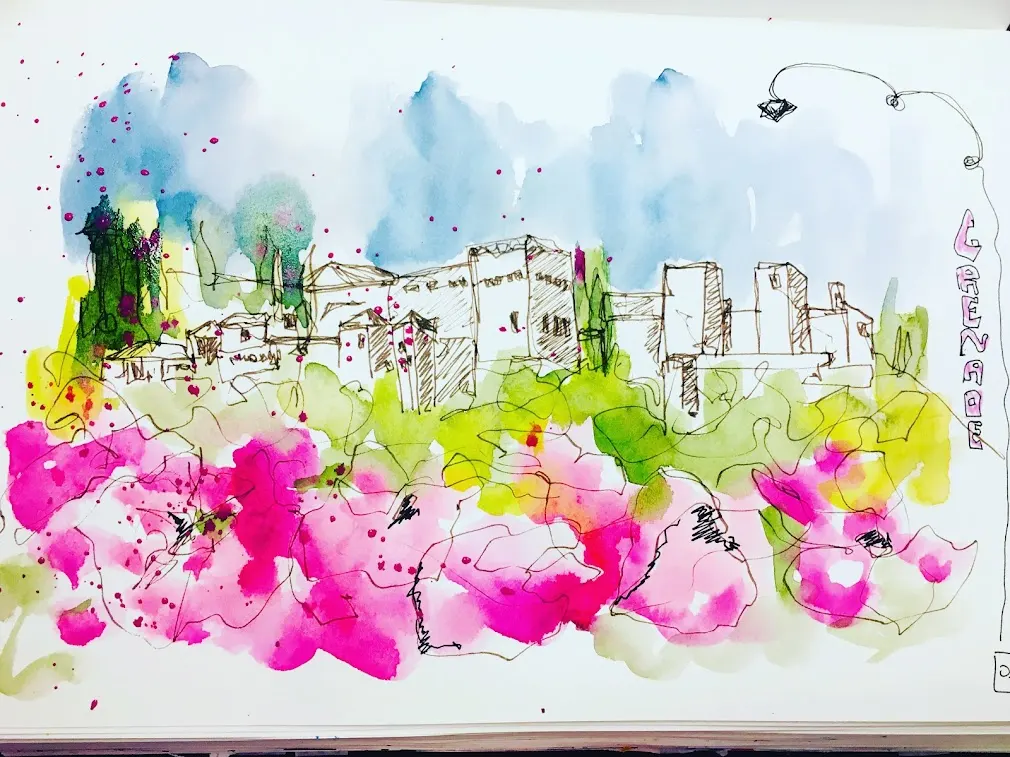
The minutes spent waiting for a train are often wasted, yet they make an ideal training ground for getting started with travel sketching. Drawing fast, without pencil or eraser, frees the line and helps you get past the fear of the page. A method with three timers (30 seconds, 2 minutes, 5 minutes) is enough to fill a sketchbook from your very next journey. You will find a pocket kit, tips for drawing travelers respectfully, mistakes to avoid, a way to add a watercolor wash afterwards, and a challenge to take up.
Speedsketching, or the Art of Drawing Fast
In November 2026, speedsketching workshops are multiplying among urban sketchers. The principle is simple: draw fast, on location, without striving for perfection. It is an excellent way into travel sketching.
In Zurich, the workshop "Ferrari on Paper", presented by Urban Sketchers, rests on three priorities: speed, simplicity and clarity. Another Zurich workshop is even held in the central station, in the middle of the crowd.
This trend offers a very concrete idea. A train station, a platform or a departure lounge is the traveler's first place to draw. Waiting time becomes drawing time.
Why Speed Frees the Line
- There's no time to correct. The line stays just as it came, and it gains confidence.
- You go straight to the essentials. A posture, a shape, a direction: the rest can wait.
- The page comes alive. Lines that spill over and unfinished shapes convey movement better than a polished drawing.
Why the Train Station Is the Best Training Ground
Subjects in Abundance
Within a few meters, you'll find enough to fill an entire sketchbook:
- travelers standing, sitting, rushing or asleep;
- suitcases, backpacks, strollers;
- information boards and clocks;
- glass roofs, arches, pillars;
- trains at the platform, seen head-on or speeding away.
Models Who Are Waiting
People who are waiting hardly move. For starting a travel sketchbook, it's ideal. On the Urban Sketchers blog, Lopa Shigaki describes getting into the habit of drawing on the train for lack of time to paint.
She began by drawing shoes and hands. Then she moved on to silhouettes, and finally to whole figures. This progression holds true for everyone.
You Go Unnoticed
In a station, everyone is absorbed in their journey. A small sketchbook resting on your knees rarely draws attention. It's the best place to get past the awkwardness of other people's gaze.
Stay respectful, though. Prefer people who are farther away or dozing, and turn the page if someone seems uncomfortable.
A Duration Known in Advance
The train timetable sets the length of your session. Twelve minutes before departure? You know exactly how many exercises you can fit in. This constraint helps you get started.
The Minimal Kit That Fits in a Pocket
Your travel sketchbook supplies don't need to be heavy. The Rart website reminds us of the value of traveling light with a sketchbook, a small palette, water and a cloth. It also recommends paper of around 300 gsm, which withstands moisture better.
For the station, cut back even further:
- a small A6 or A5 sketchbook with thick paper, which can take a little water;
- a fine felt-tip or a brush pen with water-resistant ink, so the line doesn't bleed under the color;
- a water brush, which replaces the jar and the cup;
- a mini palette of 3 to 6 colors, including a blue;
- a paper tissue, to wipe the brush and blot excess water.
What You Leave at Home
The pencil and the eraser. They have their place in the studio, but not in this exercise. Without them, you forbid yourself to correct, and every line becomes a decision.
The Method in 3 Timers
This is the heart of the exercise. Use your phone's timer, or count in your head. What matters is stopping when time is up.
30 Seconds: Silhouettes and Gestures
First draw a line of action: the curve that runs through the body, from head to feet. Add the mass of the body as a simple shape, then the suitcase or bag. Stop.
Fill half a page this way with silhouettes packed tightly against one another. They can overlap.
Tip: someone moves? Go on to the next one, or finish from memory. Your eye has already recorded the essentials.
2 Minutes: A Seated Figure or an Object
Choose a seated traveler, a clock, a bench or a vending machine. Draw simple outlines, without details. No shoelaces, no buttons, no numbers on the clock face.
Two minutes are enough to observe proportions. How many heads tall is the body? Where does the elbow fall in relation to the backrest?
Tip: spot the poses that repeat. The traveler bent over their phone or leaning on their suitcase comes up again and again. If your model leaves, another will take the same pose.
5 Minutes: A Small Scene
Now you put together what you have learned:
- Draw the horizon line, at eye level.
- Place 2 or 3 large architectural shapes: an arch, a glass roof, the edge of the platform.
- Add the silhouettes you have already practiced, larger in the foreground, smaller in the distance.
Tip: draw first what is closest to you. The rest slips in behind, without lines crossing needlessly.
Adding Color Afterwards
Color can wait. As Lopa Shigaki recommends, draw with a pen on site, then add color later. The train or a café will do very nicely.
- A quick wash of one or two colors. A diluted blue for the glass roof, a warm gray for the floor. No need to fill every shape.
- The date, the time, the platform number and the destination. These few words turn a sketch into a real travel sketchbook page.
- The lettering on a sign. The name of the station or a copied timetable gives the page character.
This is where travel watercolor really comes into its own: little water, few colors, lots of light. Isabelle Santori now paints in ink and watercolor, and her blues are her signature. A single well-chosen blue is often enough to unify a page.
Common Mistakes
- Starting with the details. The face or the suitcase buckle first, and the silhouette has no room left. Always go from large to small.
- Trying to finish a figure who has left. Leave it unfinished. An incomplete shape has its place in a living sketchbook.
- Taking a sketchbook that's too big. An A4 is intimidating and fills slowly. An A6 is quickly finished, and that feeling is encouraging.
- Apologizing for drawing. You're not bothering anyone. If someone asks what you're doing, simply show your page.
Your Challenge for the Next Journey
At your next departure, arrive ten minutes early and take up this challenge:
- a page of 10 silhouettes, 30 seconds each;
- a 2-minute page: one figure or one object;
- a 5-minute scene with horizon, architecture and travelers;
- on the train: a wash, the date, the time and the destination.
Don't judge the result on the same day. Instead, compare your pages after five or six journeys: the difference shows.
Summary box: Pocket kit + 3 timers
Pocket kit: A6 or A5 sketchbook with thick paper, water-resistant felt-tip, water brush, mini palette of 3 to 6 colors including a blue, paper tissue. No pencil, no eraser.
30 seconds: line of action, body mass, suitcase. Half a page.
2 minutes: a seated figure or an object, simple outlines.
5 minutes: horizon, 2 or 3 architectural shapes, then the silhouettes.
Afterwards: wash of one or two colors, date, time, platform, destination.
From Quick Pages to Accomplished Sketchbooks
These small, quick pages are the raw material of every accomplished travel sketchbook. They train the eye and the hand, and they keep a record of every departure. When it's too cold on the platform, the exercise also carries over very well indoors, with our method for travel sketching in the museum.
Isabelle Santori's sketchbooks and watercolor box never leave her side: she paints her travel sketchbooks on site. To see where this practice can lead, discover her books born from sketchbooks painted on location: Palette Marocaine, INDEscriptible and L'Infusion Bleue.
Isabelle also gives travel sketchbook and painting classes and workshops, presented on her artist's website. In the meantime, slip a sketchbook into your pocket: your next travel sketch begins on the platform.
Key points
| Section | Key messages |
|---|---|
| Speedsketching | Urban sketchers' trend in 2026 (workshops in Zurich, including one in a train station). Speed, simplicity, clarity: you don't correct, you go to the essentials, the page comes alive. |
| Why the train station | Varied subjects, still travelers who are waiting, you go unnoticed, known duration thanks to the timetable. Stay respectful of the people you draw. |
| Pocket kit | A6 or A5 sketchbook with thick paper, water-resistant felt-tip, water brush, mini palette of 3 to 6 colors including a blue, tissue. No pencil, no eraser. |
| 30 seconds | Line of action, body mass, suitcase. Half a page of silhouettes. If the person moves: go on to the next one or finish from memory. |
| 2 minutes | Seated figure or object in simple outlines, without details. Spot the poses that repeat. |
| 5 minutes | Horizon, 2 or 3 architectural shapes, then the silhouettes. Draw what is closest first. |
| Color afterwards | Wash of one or two colors, date, time, platform, destination, lettering from a sign. |
| Common mistakes | Starting with details, trying to finish a figure who has left, sketchbook too big, apologizing for drawing. |
| Challenge | 10 silhouettes, a 2-minute page, a 5-minute scene on your next journey. |
| Going further | Isabelle Santori's books drawn from her sketchbooks painted on site, travel sketchbook and painting classes and workshops. |