
14 November 2026
Travel Sketchbook: 6 Questions to Learn from Original Sketchbooks in Clermont-Ferrand
By L'atelier d'Isabelle Santori · Lire cet article en français
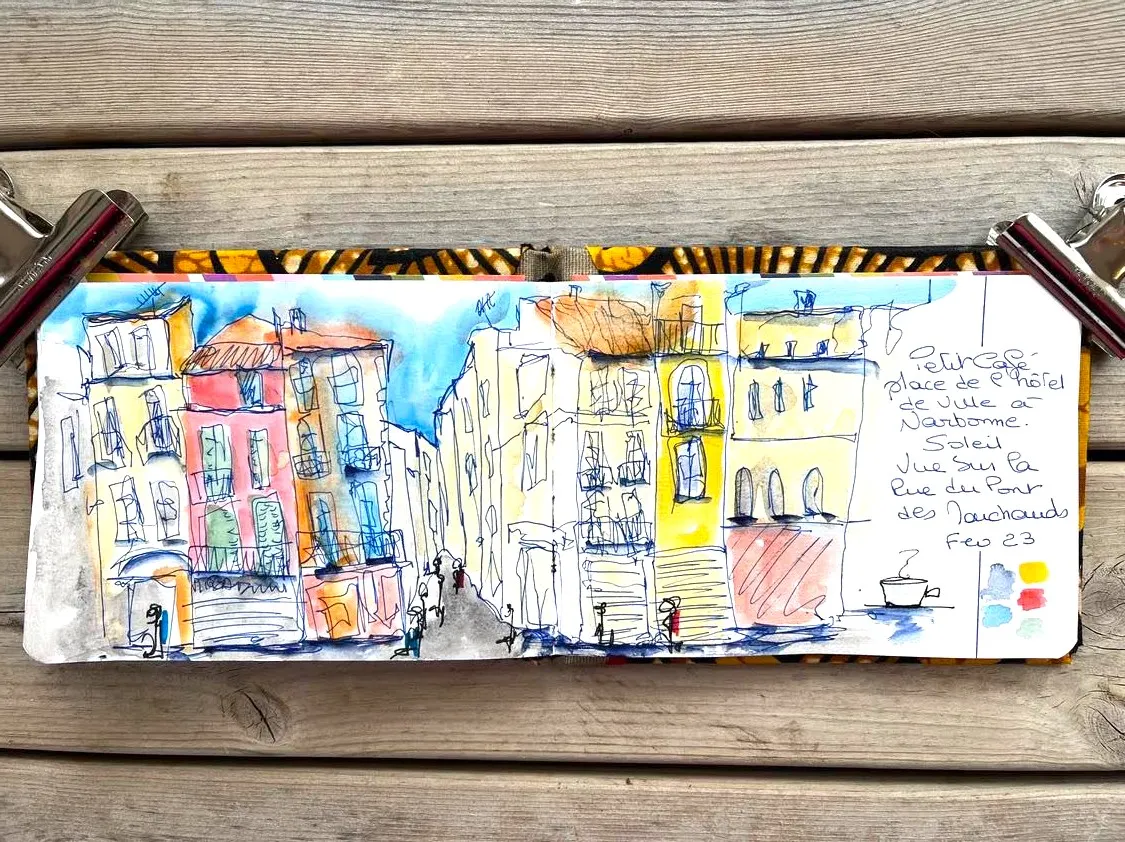
In front of an original sketchbook, you admire it, but you often leave without any concrete technique. From 13 to 15 November 2026, the Rendez-vous international du Carnet de Voyage in Clermont-Ferrand offers a chance to look differently. A visit becomes a real drawing lesson when you prepare for it with a reading grid. In this article, you will learn to ask 6 questions of each double page, to do the layout thumbnail exercise and to build your own library of structures. The method also works at a local fair, an exhibition, or with a sketchbook artist's book.
Clermont-Ferrand Travel Sketchbook Festival: Looking in Order to Learn
From 13 to 15 November 2026, the travel sketchbook festival returns to Clermont-Ferrand. The Rendez-vous international du Carnet de Voyage brings together more than 130 guests at the Polydome, including nearly 90 sketchbook artists. On the programme: exhibitions of original sketchbooks, talks, debates, films and workshops.
Standing in front of an original sketchbook, you admire it. You think, "It's beautiful, but how is it done?" And you often leave without a single technique to take home.
Here is a method to turn your visit into a drawing lesson. First, a grid of 6 questions to ask in front of each double page. Then, a thumbnail exercise to do in your own sketchbook.
This method works far from Clermont-Ferrand too: at a local fair, an exhibition, or with a sketchbook artist's book.
Why the original teaches more than the reproduction
The idea may be surprising. An hour in front of ten original sketchbooks often teaches more than a hundred images on a screen.
The screen flattens everything. It displays every page at the same size, under the same light. In front of the original, you see what the photo erases:
- the grain of the paper, which explains why the watercolour bled or didn't;
- the pencil marks under the colour, which reveal the order of work;
- the corrections, the crossings-out and the stains left on purpose;
- the thickness of the ink and the pressure of the line;
- the actual size of the sketchbook, often smaller than you imagine.
The festival presents travel, reportage and testimony sketchbooks. You will come across watercolour, drawing, comics, and even digital or audio sketchbooks. All the more reason to arrive with a reading grid.
The 6-question grid for each double page
Allow two to three minutes per double page. There's no need to analyse everything: choose the ones that stop you in your tracks.
1. What are the format and orientation of the sketchbook?
Landscape or portrait? Small pocket sketchbook or large format? Does the drawing cross the fold, or does each page stand alone?
The format guides the eye. A landscape sketchbook invites panoramas; a portrait format suits façades and figures.
To try in your sketchbook: for your next page, run a single drawing across the whole double page, fold included.
2. Where is the page's entry point?
Note what your eye looks at first. Then ask yourself why: strong contrast, a vivid colour, an element larger than the others?
Canson's layout tips remind us that a page rests on three components: image, text and empty space. The entry point comes from their balance.
To try in your sketchbook: decide before you begin which element will be seen first. Give it the strongest contrast on the page.
3. How much room for white?
Estimate the share of paper left empty: a quarter, a half? Observe where it sits: in the margin, around the subject, between two sketches.
White lets the page breathe. Without it, even a beautiful drawing looks stifled.
To try in your sketchbook: stop your next sketch short of the edges. Let the subject melt into the paper instead of framing it.
4. How do text and image coexist?
Look for handwriting woven into the drawing, captions, dates, glued-in tickets, cartouches. Text informs, but it also composes the page.
Look at its size, weight, slant, colour and placement. A line of writing can serve as a border or link two drawings.
To try in your sketchbook: write your next note following the contour of a drawing, rather than in a straight line under the image.
5. What palette?
Count the colours actually used. There are often fewer than you think.
Also look for a signature colour: the one that comes back from page to page and makes the sketchbook recognisable at first glance.
To try in your sketchbook: paint a page with just three colours, chosen before you open your travel watercolour box.
6. What was done on site, and what was reworked afterwards?
Look for clues. A quick line, splashes, notes of time or place often signal work done on location. A smoother finish, careful lettering or an added collage sometimes betray a later reworking.
There is no right answer. But knowing how to tell the two apart is liberating: not everything needs to be finished on site.
To try in your sketchbook: on site, draw and note the time. In the evening, add only the text and one colour.
The layout thumbnail exercise
This is the exercise that turns looking into a tool. Choose five double pages that you like.
For each one, draw a thumbnail of about 4 x 6 cm in one minute. Don't copy anything of the drawing. Note only the masses:
- the drawing areas, shaded in grey;
- the text areas, as a few horizontal strokes;
- the white areas, left empty;
- the dominant patch of colour, with a hatch mark or a word.
One minute is short, and that's deliberate. The constraint forces you to see the structure rather than the details. It is the same principle as the 3-timer method for travel sketching at the train station, handy if you come by train.
Back home, take one of these thumbnails as a plan for your next page.
Copying a structure is not copying a drawing
The thumbnail keeps only the framework: a large block on the left, a column of text on the right, white space at the bottom. Your subject, your line and your colours remain your own.
A musician learns chord charts before composing. The layout of a travel sketchbook is learned in the same way.
The small visiting kit
Keep it light. For a day at the festival, here are the essentials:
- a small pocket-size sketchbook;
- a pencil or a pen;
- possibly three or four coloured pencils, to note the dominant hue;
- your questions prepared for the sketchbook artists.
No water or paint near the original sketchbooks on display. Follow the venue's rules, especially regarding photos, and check with the organisers.
These rules of discretion and dry materials apply in every cultural venue. Our article on sketching in the museum for your travel sketchbook details the method.
Three questions to ask the sketchbook artists
The meet-the-artist sessions are a chance to complete your grid. Prepare two or three specific questions:
- What materials did you take for this sketchbook?
- How long do you spend on site for a double page?
- Why did you choose this format?
Not in Clermont-Ferrand this weekend? Apply the grid to a sketchbook artist's book
The grid also works with a travel sketchbook book. Printing erases the texture, but the composition, the white space and the palette remain legible.
Isabelle Santori's three books, drawn from sketchbooks painted on location, lend themselves well to the exercise. They are presented on her travel sketchbook books page.
- Palette Marocaine (2023): Morocco in warm tones. A good resource for question 5 on the palette.
- L'Infusion Bleue: Morocco in blue, 25 x 20 cm, 60 pages. Ideal for observing how a dominant colour is handled, as blues are Isabelle's signature.
- INDEscriptible: India and Rajasthan over more than 100 pages. Plenty of material to observe how a narrative is built over time.
The comparison exercise
Apply question 5 to two books with opposite palettes: Palette Marocaine and L'Infusion Bleue. Same country, two colour choices.
For each, note the number of colours, the dominant one, and where the white comes in. Then make one thumbnail per book and place them side by side.
With INDEscriptible, try questions 1 and 4 instead, across several consecutive double pages. Observe how format and text set the rhythm of the story.
Your layout library
Keep your thumbnails together, on a dedicated page of your sketchbook. This will be your "layout library", to open when a blank page blocks you.
Every exhibition, every fair, every book can enrich it with five new structures.
To go further, Isabelle Santori, a painter based in the Aude, teaches travel sketchbook and painting classes and workshops. You can discover her work in ink and watercolour on her website.
Key points
| Section | Key messages |
|---|---|
| Clermont-Ferrand Festival | 13 to 15 November 2026, more than 130 guests, exhibitions of original sketchbooks, talks, debates, films and workshops. |
| Original or screen | The original shows the grain of the paper, pencil marks, corrections, the thickness of the ink and the actual size. |
| 6-question grid | Format and orientation, entry point, place of white space, text and image, palette, work done on site or reworked afterwards. |
| Thumbnail exercise | 5 double pages, 1 minute each, 4 x 6 cm thumbnail: masses only. Copy a structure, not a drawing. |
| Visiting kit | Small sketchbook, pencil, a few coloured pencils. No water or paint near the originals, venue rules respected. |
| Without going to the festival | Apply the grid to sketchbook artists' books: Palette Marocaine, L'Infusion Bleue, INDEscriptible. |
| Key takeaway | Gather your thumbnails in a layout library for your future travel sketchbook pages. |